Email production has two different kinds of work: deciding how a message should look and assembling a layout from content. When every campaign starts from a blank file, those decisions and assembly tasks become mixed together. The same structural work gets repeated even when the brand, content types and layout patterns are already familiar.
For Finom, I designed FDS Emails as a shared library of reusable atoms, sections and templates. The library supports light and dark visual themes, desktop and mobile layouts, and content of different lengths across European markets. It also gives an AI-assisted assembly step a defined structure to work with.
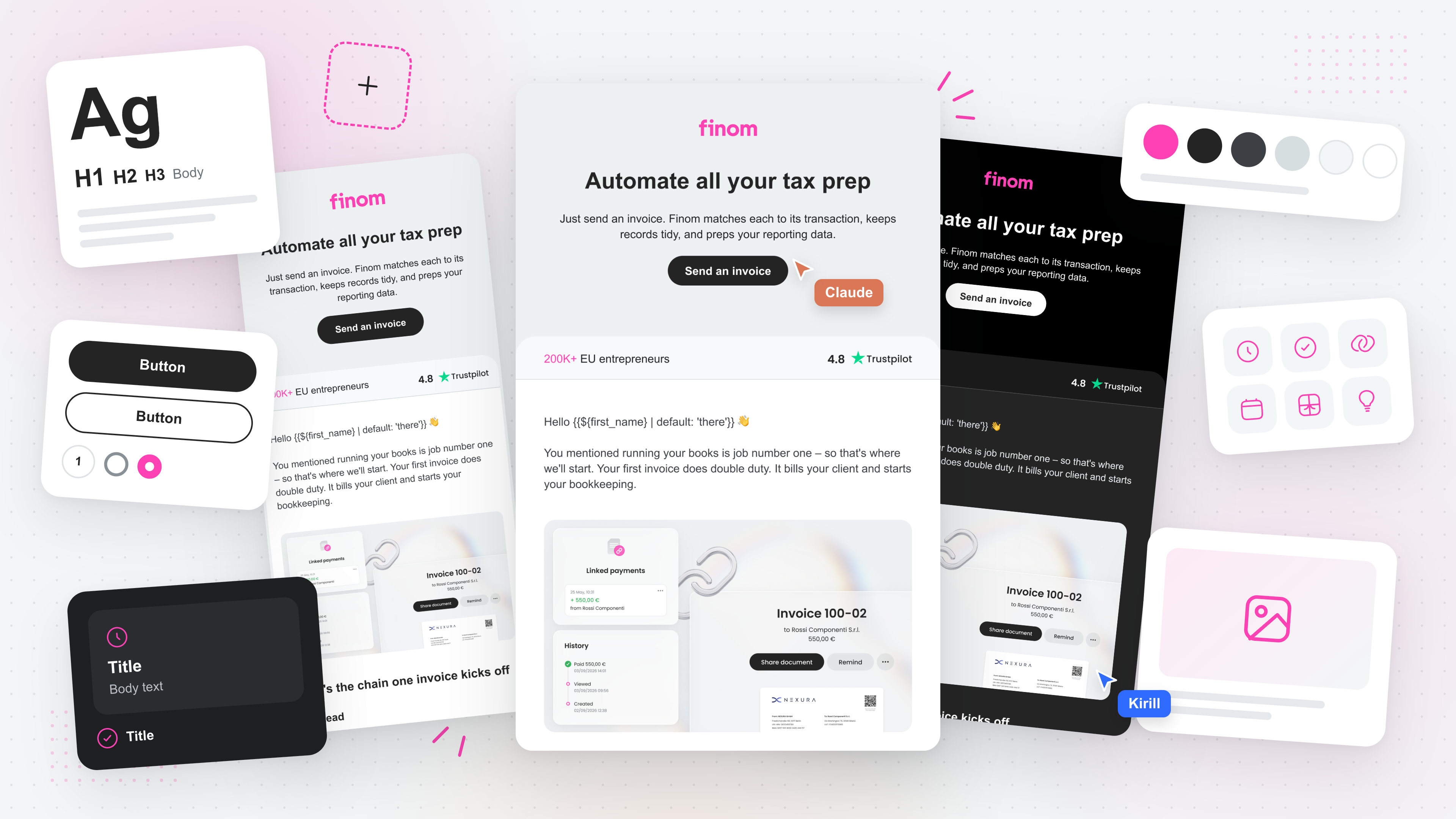
What belongs in an email design system?
A template is a starting layout. A design system describes the pieces that make layouts possible, how those pieces relate to each other and which variations are allowed. For recurring campaigns, that distinction matters: changing the message should not require redesigning the foundation.
- Atoms
- The small, reusable design elements that establish a consistent visual language.
- Sections
- Compositions built from those elements, ready to carry different types and amounts of content.
- Templates
- Complete arrangements that bring sections together for a campaign, with room for the actual message and visuals.
In FDS Emails, these layers live in a shared Figma library. The system is designed around different themes, screen sizes and text lengths. This is particularly useful when a campaign needs to work across multiple markets: the content changes while the visual structure stays coherent.
Where Google Docs and Claude enter the workflow
The content comes from Google Docs. Claude uses that copy and the Figma library to assemble the structure and content of an email. The reusable library provides the design context; the copy provides the material the campaign needs to communicate.
The designer then adds the campaign visuals and performs the final review. In other words, there is a clear handoff between assisted assembly and design judgment. The workflow gives the designer a structured draft to work with, rather than treating an AI-generated layout as a finished campaign.
- Start with the campaign copy. Use the content as the input for the email, rather than filling a generic layout with placeholder text.
- Assemble with the component library. Claude brings the structure and content together using the shared design system.
- Add the campaign visuals. The designer supplies the visual assets and checks how they work with the message.
- Review before handoff. Check composition, responsiveness and final quality before delivering the campaign to stakeholders.
Why variable content matters
A reusable system has to accommodate real copy. A short heading and a long heading create different compositions; translated content can change the amount of space a section needs. Desktop and mobile layouts also need to carry the same message at different widths.
That is why the Finom system includes support for content of different lengths, responsive layouts and visual themes. These are design requirements for the component library, not details to leave until the final campaign is assembled.
What I check in the final design review
The review connects the reusable structure to the actual campaign. I look at the hierarchy of the message, the relationship between text and imagery, how the composition works at different sizes and whether the result still feels consistent with the brand.
When planning a similar system, it helps to agree who owns the copy, the visual assets, the component library and the final approval. Email coding, platform setup, inbox rendering tests and sending are separate parts of the wider email process; their responsibilities should be agreed in the project scope.
The result: delivery to stakeholders became 3× faster
This workflow reduced email delivery time to stakeholders by three times while keeping campaigns consistent and scalable. The improvement concerns the production and handoff process. It is a useful measure of the system's practical value: how quickly a team can turn content into a reviewed design.
The reusable library and the assisted assembly step work together. The components define a repeatable foundation; Claude helps assemble a draft; the designer shapes the visuals and reviews the result.
When this approach fits a team
A modular email system is worth discussing when a team regularly produces campaigns, repeats the same layout work or needs consistent designs across markets and content variations. For a single one-off email, a focused campaign design may be the more appropriate scope.
If you need the templates and component library, explore my email design service. If your main challenge is the recurring production process, see AI design workflow automation. You can also inspect the original Finom Email design system case.